Reviewed July 2026
Filing for Divorce in District of Columbia
A plain-language look at how divorce works under District of Columbia law: who can file, how long it takes, what it costs, and where District of Columbia's own court forms and self-help resources are.
Virdix's document-preparation product currently prepares divorce paperwork for California and Florida cases. This page explains how the process works under District of Columbia law, using District of Columbia's own court forms and self-help resources, for people researching before they file. It is not legal advice, and Virdix does not prepare or file District of Columbia divorce paperwork. See how Virdix works for California divorces.
Get notified when Virdix reaches District of Columbia
We'll send one email, nothing else, the day District of Columbia launches.
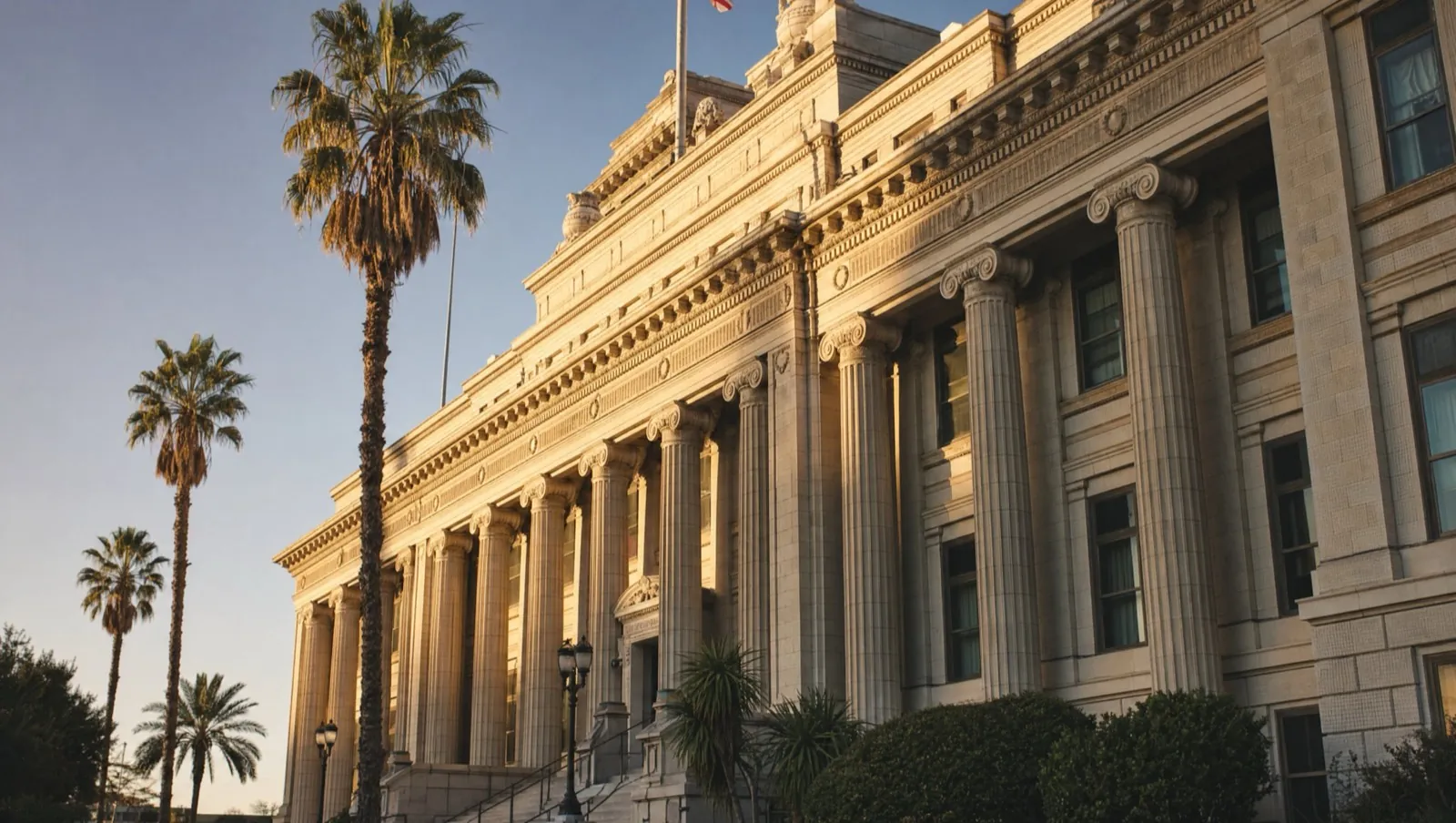
DC is not a state; divorce is handled by the Superior Court of the District of Columbia, Family Court, Domestic Relations Branch, under DC Code rather than a state code.
DC is procedurally unusual on two fronts beyond simply not being a state. First, since January 2024 (Elaine's Law, D.C. Law 25-115), DC is believed to be the only U.S. jurisdiction where a divorce can be granted on nothing more than one spouse's assertion that they no longer wish to be married, with zero separation or waiting period, a deliberate reform aimed at removing barriers for domestic violence victims who previously had to prove months of separate living before a court would act. Second, because DC has no counties, there is no venue question of the kind that exists in every state: every DC divorce is filed in the same single Domestic Relations Branch of the same single Superior Court, and all case filings funnel through one Family Court Central Intake Center regardless of where in the District the parties live.
Grounds for divorce in District of Columbia
No-fault grounds
- Assertion by one or both parties that they no longer wish to remain married (DC Code § 16-904, no separation period required), the sole ground
As of January 26, 2024 (D.C. Law 25-115, 'Elaine's Law'), DC eliminated its prior separation-period requirement entirely and is purely assertion-based, with no need to prove irreconcilable differences or fault. Traditional fault concepts survive only in the separate annulment grounds (bigamy, fraud/coercion, incapacity, underage marriage), which are not grounds for divorce itself. A legal separation (a distinct action from divorce) may be granted on similar bare assertion by one party.
Source: code.dccouncil.gov
Who can file: residency rules
No action for divorce or legal separation is maintainable unless one of the parties to the marriage has been a bona fide resident of the District of Columbia for at least 6 months next preceding the commencement of the action (DC Code § 16-902). Only one spouse needs to meet this threshold; it does not matter where the marriage took place or where the other spouse lives. A member of the U.S. armed forces who resides in DC for a continuous 6-month period during their military service is deemed a DC resident for this purpose.
DC Code § 16-902
Source: code.dccouncil.gov
How long it takes
None. As of January 26, 2024 (D.C. Law 25-115, the "Grounds for Divorce, Legal Separation, and Annulment Amendment Act of 2023," also known as Elaine's Law), DC eliminated its prior separation-period requirement entirely. Before that date, DC Code § 16-904 required either a mutual and voluntary separation of at least 6 months, or a non-mutual separation of at least 1 year, before a divorce could be granted. That requirement no longer exists on the books.
DC Code § 16-904, as amended by D.C. Law 25-115 (effective Jan. 26, 2024), no waiting period currently in force
Source: code.dccouncil.gov
That figure is the statutory floor, not a promise. Service, exchanging financial disclosures, and the court's own hearing calendar routinely add time on top of it, and a contested case takes longer than an uncontested one regardless of the minimum. California, by comparison, requires a mandatory six month waiting period from the date of service.
Cost and filing fees
$80.00 to file a Complaint for Absolute Divorce (or other initiating petition) in DC Superior Court Family Court, per the court's published Family Court filing fee schedule. (A counterclaim is $20.00; other miscellaneous fees apply for motions, writs, and certified copies.)
Source: dccourts.gov
California's own statewide filing fee is generally $435 to $450 statewide, with a fee waiver available for those who qualify.
Divorce forms and papers
The petition
Complaint for Absolute Divorce. DC Superior Court publishes this as a standardized fillable PDF form with no separate numeric form identifier printed on it (unlike some jurisdictions that assign form numbers such as "Form 106A"). Related companion forms: Consent Answer to Complaint for Divorce, and Joint Request for Uncontested Divorce Hearing.
Source: dccourts.gov
Fee waiver
Fee Waiver Application, Application to Waive "Prepayment of" Costs, a court-wide DC Superior Court form (available in English, Spanish, and Amharic) used across divisions including Family Court, filed pursuant to DC Code § 15-712. There is no separate, uniquely-numbered Family Court-specific fee waiver form.
Source: dccourts.gov
District of Columbia publishes fillable forms for this process.
California uses standardized Judicial Council forms, starting with the Petition (Form FL-100), across every county. See California's own divorce forms.
Filing online
Optional for self-represented (pro se) parties, mandatory for attorneys (unless excluded by administrative order). Family Court / Domestic Relations divorce filings are handled through CaseFileXpress / File & ServeXpress, not the newer eFileDC system (efiledcsuperiorcourt.gov), which is limited to the Civil Division, Probate Division, Civil Tax cases, and the Office of Auditor Master.
Source: dccourts.gov
Uncontested and simplified divorce
District of Columbia does not have a separate statutory simplified or summary divorce track. An uncontested case still uses the standard process, it just moves faster because there is nothing to litigate.
DC has no separate statutory "summary dissolution" track with its own eligibility thresholds (e.g., short marriage, no children, low asset value) comparable to California's summary dissolution. Instead, spouses who agree on all issues can use a streamlined uncontested path within the standard case type: the responding spouse files a Consent Answer, and the parties file a Joint Request for Uncontested Divorce Hearing to resolve the case without a contested trial.
Source: dccourts.gov
California's equivalent is uncontested divorce in California, which uses the same statewide forms as any other case but moves faster once both spouses agree on every term.
Filing without a lawyer
District of Columbia allows self-represented filers, and most divorces filed in the state proceed this way. Because Virdix prepares divorce paperwork for California and Florida cases only, a District of Columbia filer handling their own case works directly from District of Columbia's own forms and self-help materials rather than a Virdix-prepared packet. District of Columbia's official self-help resources are the direct source for the current forms and instructions.
For how self-representation works in the states Virdix does serve, see divorce without a lawyer in California, DIY divorce vs. hiring a lawyer, or how Virdix works for Florida divorces.
More about divorce in District of Columbia
How property is divided
Equitable distribution, not community property. DC Code § 16-910 directs the court to distribute marital property (and debt) accumulated during the marriage "in a manner that is equitable, just, and reasonable," after considering all relevant factors, not an automatic 50/50 split.
Source: code.dccouncil.gov
Court structure
The Superior Court of the District of Columbia is DC's single unified trial court of general jurisdiction, DC has no counties and no county-level court system. Divorce cases are heard in the Family Court's Domestic Relations Branch, and all filings first pass through the Family Court Central Intake Center at the Moultrie Courthouse (500 Indiana Ave. NW). There is no separate "family court" as an independent judicial entity; it is a specialized division/branch of the single Superior Court.
Source: dccourts.gov
Spousal support
No formulaic statewide guideline; alimony is discretionary. Under DC Code § 16-913, the court "may require either party to pay alimony to the other party if it seems just and proper," weighing factors including the requesting party's ability to become self-supporting, time needed for education/training, standard of living during the marriage, duration of the marriage, circumstances of estrangement (including abuse), age and health of each party, and each party's financial needs and resources. Awards may be indefinite or term-limited and can be made retroactive to the filing date of the request.
Source: code.dccouncil.gov
Child support guideline
Income Shares model. DC Code § 16-916.01 directs courts to determine each parent's percentage share of combined adjusted gross income, then allocate the basic child support obligation proportionally between the parents based on that share.
Source: code.dccouncil.gov
Residency exceptions
A member of the U.S. armed forces stationed in DC for a continuous 6-month period during military service is deemed a DC resident for purposes of the 6-month rule. Separately, same-gender couples married in DC may bring a divorce or legal-separation action in DC courts even if neither party is currently a DC resident, provided the marriage was performed in DC and neither party resides in a jurisdiction that will hear the case, a carve-out addressing the period before nationwide marriage equality when some same-sex couples had no other forum available.
Source: code.dccouncil.gov
More District of Columbia guides
California is the only state on this site with a full county-by-county breakdown. See how California's divorce process compares across its 58 counties.
This page is general information about District of Columbia divorce procedure, not legal advice for your situation. Laws, fees, and forms change over time; confirm current details with District of Columbia's own courts before relying on anything here. Virdix is not a law firm and is not licensed to practice law in District of Columbia. Virdix does not prepare or file District of Columbia divorce paperwork. It is not a substitute for an attorney licensed in District of Columbia.
Divorce guides for nearby states
Virdix currently serves California and Florida
In the states Virdix serves, it guides you through that state's own court forms so your paperwork is complete and consistent before you file. If you're filing in District of Columbia, the official resources linked above are the right place to start, and the form below will tell you the moment Virdix reaches your state.
If the court clerk rejects a document we prepared, we fix it for free until it's accepted. See how the guarantee works